
Nursing Informatics: Transforming Healthcare through Technology and Data Analysis
Nursing informatics is a key driver in modern healthcare, uniting nursing science, information technology, and data analysis. It boosts patient care by managing and sharing meaningful data, information, or knowledge. But that’s not all. Imagine the power of technology assisting in patient care delivery – think electronic health records, telehealth services, mobile health apps. These are no longer concepts of the future. This is Nursing Informatics today. Let’s dig deeper.
Nursing informatics integrates nursing science with information and analytical sciences to manage and communicate data, information, knowledge, and wisdom in nursing practice. This field has significantly contributed to the implementation of technologies such as electronic medical records (EMRs) and computerized provider order entry systems to enhance patient safety and improve healthcare workflows.

Defining Nursing Informatics
Nursing informatics is like the conductor of an orchestra, bringing together different parts to create harmonious music. It integrates nursing science with information and analytical sciences to manage and communicate data, information, knowledge, and wisdom in nursing practice. It’s all about understanding how to use technology in the field of nursing to improve patient care—to help nurses do their jobs more effectively, provide better care for patients, and make healthcare systems work more smoothly.
Viewing it at a deeper level, it’s not just about using computers in nursing. It also involves data analysis. This means taking a good hard look at all the information and numbers collected from patients. Think about it as if you’re putting together a puzzle to find the best way to help people—the more pieces you have, the clearer the picture becomes.
Fundamental Concepts of Nursing Informatics
Let’s break down some fundamental concepts of nursing informatics:
| Fundamental Concept | Description |
|---|---|
| Data Management | Involves collecting, organizing, and making sense of all the different kinds of information that nurses use every day. |
| Information Technology (IT) | Equips nurses with the necessary skills to utilize technology effectively in their daily tasks. |
| Data Science | Utilizes analytics to study patient information and derive insights for better care delivery. |
| Patient Care Enhancement | Nursing informatics aims to enhance patient care and healthcare outcomes by leveraging technology and data-driven insights. |
Understanding these fundamental concepts gives us a glimpse into the multifaceted nature of nursing informatics and how it significantly impacts modern healthcare delivery.
The multifaceted nature of nursing informatics serves as a strong foundation for embracing diverse applications and innovative tools that are revolutionizing modern healthcare.
Applications and Healthcare Tools
Nursing informatics isn’t just a theoretical concept—it’s deeply entwined with everyday healthcare practices through a variety of applications and tools. These technologies play a crucial role in improving patient care, streamlining workflows, and enhancing the overall efficiency of healthcare delivery. Let’s take a closer look at some of the key applications and tools used in nursing informatics.
Electronic Health Records (EHRs)
Electronic health records (EHRs) have revolutionized the way patient information is stored and accessed. They enable healthcare providers to access a patient’s medical history, diagnoses, medications, treatment plans, immunization dates, allergies, radiology images, and laboratory test results, all within a centralized digital platform. This centralized system ensures that essential patient data is readily accessible to healthcare professionals across multiple disciplines, ultimately leading to more coordinated and informed care.
Clinical Decision Support Systems
Clinical decision support systems provide clinicians with invaluable assistance as they make decisions about patient care. These systems utilize patient data to offer evidence-based clinical knowledge and patient-specific information, aiding healthcare professionals in making accurate diagnoses and formulating effective treatment plans. By leveraging these systems, clinicians can stay updated on current best practices and ensure that they are delivering the highest quality of care.
Telehealth and Mobile Health Applications
The rise of telehealth and mobile health applications has transformed the delivery of healthcare services. Through telehealth platforms, patients can remotely consult with healthcare providers, receive medical advice, and even undergo virtual examinations. Mobile health applications empower individuals to actively engage in managing their health by tracking vital signs, medication adherence, and overall wellness. These applications not only promote proactive healthcare management but also enhance accessibility to care for individuals in remote or underserved areas.
Patient Care Management Software
Patient care management software serves as an essential tool for coordinating comprehensive care plans for individual patients. These platforms facilitate communication among interdisciplinary care teams, support care plan development, monitor patient progress, and assist in identifying opportunities for intervention. By integrating various aspects of patient care into a unified system, these software solutions maximize efficiency, minimize errors, and improve patient outcomes.
Understanding the practical utilization of these tools sheds light on the significant impact they have on enhancing patient care. As nursing informatics continues to evolve, these applications serve as instrumental resources in driving positive transformations in healthcare delivery.
Now that we’ve looked at how technology is transforming healthcare delivery through nursing informatics tools and applications let’s explore the tangible benefits it brings to advancing patient care.
Advancing Patient Care: Benefits of Nursing Informatics
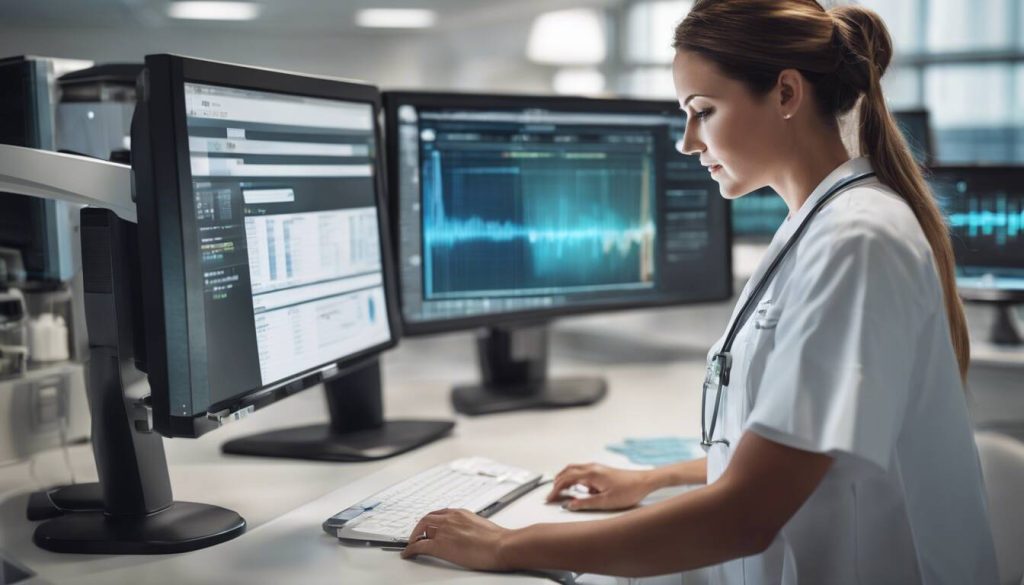
Nursing informatics isn’t just about technology – it plays a significant role in directly impacting patient care. By harnessing the power of comprehensive patient data, nursing informatics empowers healthcare professionals to make more informed decisions, ultimately transforming the quality of care patients receive.
Access to comprehensive patient data is vital for delivering personalized care plans. When nurses have easy access to a patient’s medical history, current medications, and other crucial information, they can tailor their approach to meet the individual’s specific needs. This level of personalization ensures that patients receive the most effective and safe treatments.
Streamlining workflows is another significant benefit of nursing informatics. By integrating technological solutions, such as electronic health records (EHRs) and clinical decision support systems, nurses can efficiently manage patient information, reducing the time spent on administrative tasks and allowing them to focus more on direct patient care. This leads to increased efficiency and improved overall workflow, ultimately benefiting both the patients and healthcare staff.
Moreover, one of the most notable impacts of nursing informatics is its ability to reduce medical errors. With the implementation of advanced systems for medication administration and real-time documentation, nurses can significantly decrease the occurrence of errors, ultimately leading to enhanced patient safety and improved health outcomes.
The promotion of evidence-based practice is another critical aspect facilitated by nursing informatics. By providing access to a wealth of research-backed information and data analysis tools, nursing informatics empowers nurses to make clinical decisions based on the latest evidence and best practices, thereby ensuring that patients receive the most current and effective treatments available.
Statistics show that nursing informatics has indeed led to positive patient outcomes. Studies have revealed a noticeable reduction in medication errors in healthcare facilities where nursing informatics solutions have been implemented. Additionally, there has been a substantial increase in the accuracy of patient documentation, further highlighting the impactful role of nursing informatics in improving overall patient care.
By supporting decision-making processes through data analysis and evidence-based practices, nursing informatics not only elevates the standards of care but also establishes a foundation for continuous improvement within the healthcare system. The integration of these technological advancements fosters a culture of learning, adaptation, and innovation, ultimately contributing to ongoing enhancement in patient care practices.
Incorporating nursing informatics into healthcare practices undoubtedly brings about tangible benefits for both healthcare providers and their patients alike. It’s clear that this intersection of nursing and technology is pivotal in driving positive change within the healthcare landscape.
From revolutionizing patient care with technology and data analysis, let’s now shift our focus on examining the multifaceted challenges encountered in the realm of nursing informatics.
Facets of Challenges in Nursing Informatics
Nursing informatics may be transforming healthcare, but this evolution is not without its growing pains. One of the significant challenges faced is the security and privacy of patient data. As technology advances, so do the methods and capabilities of those seeking access to sensitive information. Healthcare organizations must be vigilant in implementing and maintaining robust security measures to protect patient confidentiality.
Moreover, integrating new technologies into existing systems can prove to be quite a complex task. Often, these “new” technologies are intended to work alongside established systems, which may not always play well together. Interoperability issues can arise when different healthcare systems cannot seamlessly share and use data across platforms, leading to inefficiencies in communication and patient care.
Resistance to change is another prevalent challenge. It’s natural for individuals to feel hesitant about adopting new ways of doing things, especially if they’ve become accustomed to certain routines. Yet, in a constantly evolving field like healthcare, embracing and mastering new technologies is crucial for providing the best possible care.
Continuous training and education are vital elements to address these challenges. Nurses and other healthcare professionals must stay updated on the latest advancements and best practices in nursing informatics as technology evolves at a rapid pace.
Additionally, interoperability issues among different healthcare systems also pose significant barriers. With 64% of healthcare facilities facing interoperability challenges, there’s a clear pressing need for improved connectivity among diverse systems.
While these challenges may seem daunting, it’s important to recognize that they can be overcome with proper planning, collaboration, and adherence to best practices. Ultimately, facing these hurdles head-on could lead to more efficient and effective patient care.
Understanding these various facets of challenges in nursing informatics provides insight into the intricacies of this dynamic field and highlights areas where improvements are necessary for the continued advancement of healthcare technology and data analysis.
As we reflect on the obstacles in nursing informatics, it’s time to turn our attention to harnessing innovative approaches to address these challenges and drive forward progress in the field.
Surfing the Trend Wave in Nursing Informatics
Picture nurses not only with stethoscopes around their necks but also armed with a full arsenal of digital tools – smartphones, tablets, wearables, and AI systems. This is the new reality in nursing informatics, where technology and data analysis are revolutionizing the delivery of healthcare.
With the rise of ambulatory nurse informaticists, nurses are now taking on a more active role in managing electronic health records (EHRs) and analyzing healthcare data. They effectively bridge the gap between patient care and technology by leveraging their clinical expertise to ensure that information systems meet healthcare providers’ needs while enhancing patient outcomes.
The increasing use of telehealth and remote patient monitoring enables nurses to reach patients beyond the traditional clinical setting. This allows them to monitor vital signs, offer medical guidance, and provide support from a distance. The widespread adoption of telemedicine during the pandemic has further elevated this trend’s importance.
Imagine a nurse being able to check on a recovering patient at home through a video call or remotely adjusting a patient’s medication based on real-time data. This accessibility has the potential to enhance patient compliance and outcomes, reducing unnecessary hospital visits.
AI-powered clinical decision support systems are also reshaping nursing informatics. These systems analyze extensive patient data to assist nurses and other healthcare professionals in making well-informed decisions about patient care. They can help identify potential health risks, suggest treatment options, and streamline workflow processes.
While these advancements hold great promise, they also raise concerns about privacy, data security, and the potential for technology to replace human intuition and empathy in healthcare. It’s essential for nurses to carefully navigate these issues as they integrate technology into their practice.
As nursing roles continue to evolve in response to these trends, it’s crucial for healthcare professionals to stay updated on emerging technologies and best practices in nursing informatics.
Rapid developments in technology are shaping the future landscape of nursing informatics. Let’s now explore what’s on the horizon in terms of technological advancements impacting nursing roles.
Future Developments in Nursing Informatics
The integration of artificial intelligence (AI) and machine learning tools is set to revolutionize the landscape of nursing informatics. AI has the capability to process and analyze vast amounts of patient data, enabling healthcare professionals to make more accurate predictions and personalized treatment plans. By leveraging predictive analytics, nurses can identify potential health risks, intervene early, and tailor interventions based on individual patient needs. This shift towards proactive care management enhances patient outcomes and streamlines resource allocation within healthcare systems.
Furthermore, the expansion of telemedicine capabilities represents a significant stride in nursing informatics. Telemedicine allows for greater access to healthcare services, particularly for patients in remote or underserved areas. Nurses equipped with telemedicine tools can remotely monitor patients, provide consultations, and collaborate with other members of the healthcare team to ensure continuity of care. This expansion in telemedicine capabilities improves health equity by bridging geographical barriers and enhancing patient engagement in their own care.
Interoperable health information systems are another pivotal development in nursing informatics. The seamless exchange of patient data across different healthcare settings promotes coordinated care delivery and empowers nurses with comprehensive insights into a patient’s medical history, treatments, and outcomes. As interoperability strengthens, nurses can leverage integrated data to make informed clinical decisions, facilitate care transitions, and contribute to standardized reporting for quality improvement initiatives. The evolution of interoperable health information systems lays the foundation for enhanced care coordination and improved patient safety.
As these advancements take shape, it’s essential for nursing informaticists to stay informed about emerging technologies and practices. Embracing continuous learning and adapting workflows to incorporate these innovations will be instrumental in maximizing their impact on patient care. Through ongoing education and training programs, nurses can harness the potential of these developments to elevate the quality, efficiency, and accessibility of healthcare services.
The future of nursing informatics holds great promise, propelling the profession towards a new era of data-driven decision-making, expanded care delivery models, and heightened patient-centered outcomes that truly place the patient at the heart of the healthcare system.
Importance of Continued Education and Training
In the fast-paced world of healthcare technology, the landscape is constantly evolving. New technologies, changes in regulations, and advancements in data management practices are continually reshaping the field of nursing informatics. To keep up with these changes, it’s crucial for nursing professionals to engage in continuous learning and professional development. The complexity of modern healthcare systems and the ever-evolving nature of technology demand that nursing informaticists continue to build upon their knowledge and expertise.
Continuous education ensures that nursing informatics professionals are equipped with the most current information and skills necessary to navigate the rapidly changing healthcare technology environment. By staying informed about the latest technological advancements, professionals can effectively leverage new tools and resources to improve patient care outcomes, streamline workflows, and enhance overall efficiency. Ongoing training also helps professionals adapt to changes in healthcare regulations, ensuring compliance and ethical practice. Moreover, ongoing education and training contribute to the enhancement of critical thinking, problem-solving abilities, and decision-making skills within the nursing informatics field. It empowers professionals to analyze complex data sets, identify trends, and derive actionable insights that can drive evidence-based practice and inform strategic decision-making within healthcare organizations.
Resources for Ongoing Education
Access to resources for ongoing education and training opportunities is integral to supporting professional development within the field of nursing informatics. At our website, we are dedicated to providing a wealth of resources to aid professionals in furthering their education. These resources include:
- Certification Programs
- Webinars
- Conferences
For instance, our certification programs are designed to equip nursing informatics professionals with the skills required to excel in roles such as nurse informaticist, clinical nurse informatics specialist, or chief nursing informatics officer. By obtaining these certifications, professionals can bolster their credentials and demonstrate a commitment to excellence within the field.
By offering a robust array of educational resources, we aim to empower nursing informatics professionals to forge successful careers and make significant contributions to improving patient care outcomes through the effective utilization of technology and data management practices.
In conclusion, fostering a culture of continuous education and training within nursing informatics is essential to ensure that professionals remain at the forefront of innovation while delivering high-quality care in an increasingly dynamic healthcare landscape.